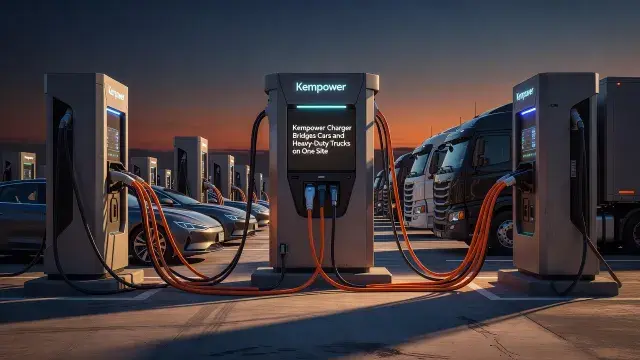
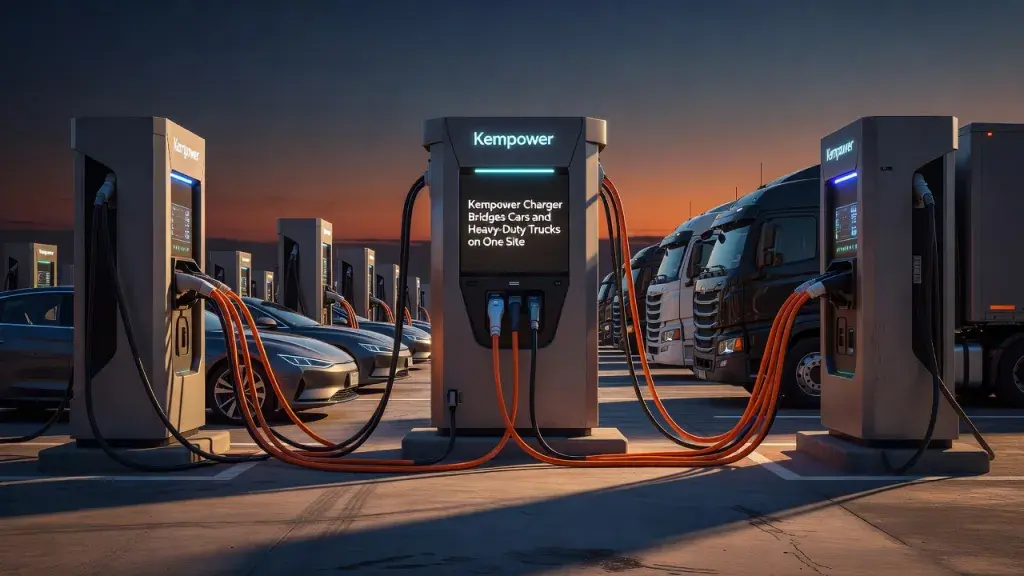
Kempower has introduced the Mega Satellite Flex, a charging unit built to serve both passenger electric vehicles and heavy-duty electric trucks from the same physical installation. The dispenser supports the established CCS standard at up to 560 kW and the emerging Megawatt Charging System at up to 1.2 MW, making it the Finnish manufacturer's first product to straddle both standards in a single housing. It was unveiled this week at the Unplug & Recharge event held alongside ACT Expo, where Kempower is showcasing the hardware to fleet operators and infrastructure partners.
Why One Dispenser for Two Standards Matters
The electric vehicle charging sector has spent the past several years building around CCS, the Combined Charging System that dominates passenger car infrastructure across North America and Europe. Trucks, however, need far more energy delivered far faster to make electrified long-haul operations viable, which is why the industry developed MCS, a standard designed for charging speeds well beyond what passenger vehicles require. Until now, site owners generally had to choose one standard or plan for two separate builds as demand shifted. The Mega Satellite Flex removes that binary choice by putting both capabilities into one unit, which is a meaningful shift for anyone comparing hardware options or watching for shifting market prices through outlets like BuyBestVPN deals and similar infrastructure marketplaces that track early-stage charging equipment.
What the Specifications Reveal About Intent
The technical figures point to a deliberate hedge against an uncertain transition period. The unit handles up to 1,500 amps on the MCS side and 700 amps for CCS, with cable lengths of 5 meters for CCS and 2.7 meters for MCS - proportions that reflect how truck charging ports are typically positioned closer to the vehicle body than passenger car inlets. An optional payment terminal signals that Kempower expects mixed public and fleet use rather than depot-only deployment. Support for 800-volt architectures also future-proofs the hardware for newer passenger models that already charge faster than older 400-volt platforms allow, so the same cabinet that serves a truck fleet by day can serve high-end electric cars without a separate retrofit.
The Business Case for Shared Infrastructure
Charging hardware is only half the equation; utilization determines whether a site turns a profit. Idle chargers are dead capital, and building separate stalls for cars and trucks historically meant duplicating land, grid connections, and civil works. By letting one dispenser serve either vehicle type, Kempower is arguing that operators can activate a site once and grow into truck demand as MCS-equipped fleets become more common, rather than gambling on a second construction phase later. Compatibility with Kempower's existing distributed charging architecture reinforces that pitch: operators already running Kempower systems can add the Mega Satellite Flex without redesigning power distribution from the ground up.
What Comes Next
The Mega Satellite Flex is scheduled to reach the North American and European markets in July 2026, giving fleet operators and charge point developers over a year to plan deployments around it. Its arrival lands at a moment when MCS infrastructure remains sparse relative to the trucks being engineered to use it, so hardware that hedges between standards may prove more valuable than equipment locked into either one. The broader question is whether other manufacturers follow with similarly dual-purpose designs, or whether the market continues to split along vehicle class lines even as the underlying grid and site infrastructure increasingly needs to serve both.