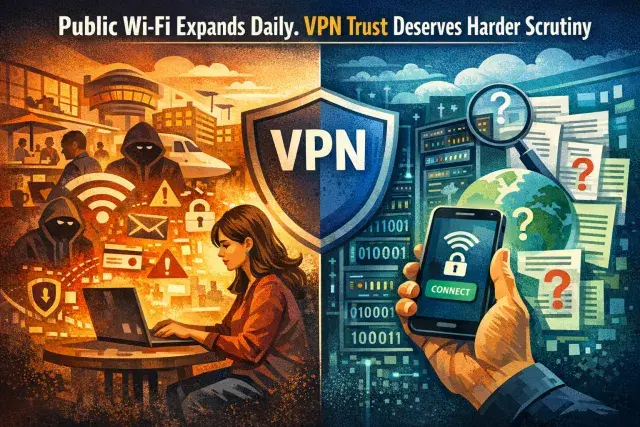

Public Wi-Fi has become routine infrastructure, woven into airports, hotels, cafés, libraries, coworking spaces, and transit hubs. That convenience has changed expectations for travel and remote work, but it has also blurred an important line: easy access is not the same as a trustworthy connection.
Shared networks are not automatically dangerous, and fear is a poor guide to digital safety. The more useful question is whether people understand the risks of using networks they do not control and whether the privacy tools they choose, especially VPNs, actually earn confidence rather than merely advertise it.
Convenience changed the network, not the underlying uncertainty
Public internet access feels ordinary because it is ordinary. Logging on through a hotel portal or a café password can seem no different from joining a home router, yet the context is different in one crucial respect: the user usually has very little visibility into who operates the network, how it is configured, or how carefully it is maintained.
That uncertainty matters most when people do more than casual browsing. Checking work files, opening email, signing into financial accounts, or sending personal information all raise the stakes. Modern websites often encrypt traffic, which offers important protection, but encryption in the browser does not remove every concern tied to a shared network or to the services handling a user’s data.
VPN marketing often promises more than it explains
This is where VPNs enter the picture. They are commonly presented as a simple answer to public Wi-Fi risk, wrapped in words such as private, secure, and anonymous. Those claims can sound reassuring while revealing very little. A VPN may reduce exposure on a shared network, but it also asks the user to place trust in another intermediary. The question does not disappear; it shifts.
A stronger standard starts with transparency. If a provider says it keeps no logs, the policy should explain what that means in practice. Does it collect browsing activity, connection timestamps, IP addresses, device information, or account records? A vague promise offers comfort without accountability. Clear documentation gives users something to judge.
Technical openness is a practical signal of credibility
Privacy claims carry more weight when a company explains how its service works. Users do not need a deep engineering background to benefit from this. They need enough information to see whether the provider connects its marketing language to real systems.
Useful signs include plain-language explanations of server design, data handling, security architecture, and what happens when systems restart or are updated. Information about where servers are located and how the network is structured can also help. None of this guarantees perfect privacy, but it shows a willingness to be examined. That is a better foundation for trust than branding alone.
Public accountability matters more than a polished homepage
Trust is rarely established by one policy page. It is stronger when a company shows a pattern of openness over time. Public transparency reports, updates on legal requests, and visible discussion of policy changes can all indicate that a provider is prepared to explain its decisions rather than ask customers to accept them on faith.
For people using public Wi-Fi, the lesson is less dramatic than many security warnings suggest. The most common risk is not cinematic cybercrime but routine overconfidence. A familiar login page or a well-designed app can make an environment feel safer than it has been proven to be. Better habits begin with a simple principle: if a service is meant to protect your privacy, its own practices should be easy to inspect.
Public Wi-Fi is now part of daily life, and for many people it is hard to avoid. That makes careful selection more important, not less. A VPN can be a sensible part of safer browsing, but only when the company behind it explains its privacy rules, its technology, and its accountability with unusual clarity.