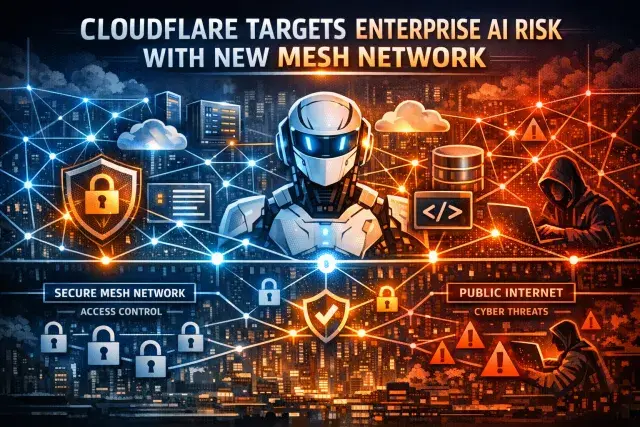

Cloudflare has introduced Cloudflare Mesh, a private networking layer built for enterprise AI agents that need access to internal systems without exposing those systems to the public internet. The launch speaks to a growing problem inside large organizations: AI tools are moving from pilots into daily operations, but the network controls around them were largely built for human employees, not autonomous software acting at machine speed.
Why AI agents are creating a new networking problem
Many enterprise AI agents do not work in isolation. Coding assistants may need to query staging databases, customer support agents may need internal knowledge bases, and operational tools may call private APIs to complete tasks. That creates a familiar security dilemma. Give broad network access and the organization increases its attack surface; lock systems down too tightly and the agent becomes far less useful.
Traditional VPNs and hand-built tunnels were designed around human logins, managed devices, and relatively predictable patterns of access. AI agents change that model. They can run continuously, operate across cloud environments, and trigger large numbers of internal requests without direct human oversight. That makes identity, scoping, and auditability far more important than simple network reachability.
Cloudflare’s answer: identity first, network exposure last
Cloudflare says Mesh assigns each AI agent its own identity, allowing security teams to define what that agent can reach in the same way they would set permissions for a user or service account. The practical aim is narrow access. An organization might allow a coding agent to work with a staging environment while blocking production finance systems or other sensitive records.
This approach reflects a broader move toward zero-trust security, where access is based on verified identity and explicit policy rather than an assumption that anything inside a network boundary is trustworthy. For AI deployments, that matters because agents can become powerful intermediaries between language models and critical business systems. If access rules are too broad, mistakes or compromises can spread quickly across internal infrastructure.
How Mesh fits into Cloudflare’s wider platform
Cloudflare is positioning Mesh as part of a larger stack that includes Workers, Workers VPC, and its Agents SDK. The strategy is clear: offer companies a way to build, run, connect, and govern AI agents inside one ecosystem rather than stitching together separate tools for compute, identity, and private connectivity.
According to the company, Mesh can connect laptops, office networks, and cloud environments across providers such as AWS and Google Cloud into a unified private network. The promise is not only convenience but a cleaner security model, where internal traffic stays private and encrypted without requiring organizations to publish internal endpoints externally just to make AI workflows function.
What the launch signals for enterprise infrastructure
Cloudflare Mesh is less a standalone product story than a sign of where enterprise architecture is headed. As AI agents take on more operational work, companies will need infrastructure that treats them as active participants in internal systems rather than as simple front-end tools. Networking, identity, and policy enforcement are becoming central design questions for AI adoption, not secondary concerns.
That shift also carries governance implications. Enterprises will need to know which agents touched which systems, under what permissions, and for what purpose. Products like Mesh are aimed at making that control practical at scale. Whether Cloudflare’s approach becomes a standard model, the underlying issue is unlikely to fade: AI in production requires private, tightly scoped, machine-oriented access to enterprise systems, and older networking habits are poorly suited to that reality.